Smart Techniques to Use ChatGPT for Sales Prospecting
Seamless Team
January 7, 2026
It seems like everyone is using AI to make money and generate sales.
It’s a question that’s likely crossed every sales rep’s mind at one point: “What about using ChatGPT for sales prospecting?”
It’s true that ChatGPT has the potential to be a rep’s best friend, taking care of busywork so you can spend more time closing deals. But for all the exciting possibilities, there are just as many questions and concerns. What is the best way to use ChatGPT for sales prospecting? Are there any limitations or ethical considerations? Is it the only AI-powered tool sales teams need?
We discuss all of this and more below.
What Is ChatGPT and How Does It Help Sales Prospecting?
ChatGPT is a generative AI tool capable of responding to detailed prompts with realistic fluency. Recent updates expanded these capabilities into web search, and even “agentic” AI that can carry out complex, multi-step tasks.
In a sales prospecting context, this allows ChatGPT to handle early-stage sales tasks such as:
Drafting cold outreach emails or LinkedIn messages
Researching publicly available information about companies and prospects
Turning blocks of complex notes into digestible summaries
And because ChatGPT is accessible from any browser, it’s easy to integrate it into team workflows without major onboarding or tech overhead.
Why Sales Teams Are Turning to ChatGPT
Adoption of ChatGPT and other AI tools in the workplace is accelerating. In fact, recent data from OpenAi indicates that 28% of the US workforce admits to using ChatGPT for work, in roles ranging from marketing to operations.
Are sales teams specifically poised to benefit? Absolutely, in several ways:
Time savings and productivity boosts – ChatGPT helps automate repetitive sales work that can bottleneck a rep’s time. This frees teams up to focus on more strategic, high-value work.
Better personalization at scale – Crafting 50 unique messages by hand used to take hours. Now, AI can breathe context into the content instantly, making sales outreach feel personal even when carried out at scale.
Faster research and data aggregation – Instead of manually combing through websites and social feeds, reps can simply ask ChatGPT to assemble info in seconds. That’s a major advantage for research and segmentation.
How to Use ChatGPT for Sales Prospecting
Despite its usefulness, building ChatGPT into your workflow may feel overwhelming at first. Thankfully, you don’t need much to get started.
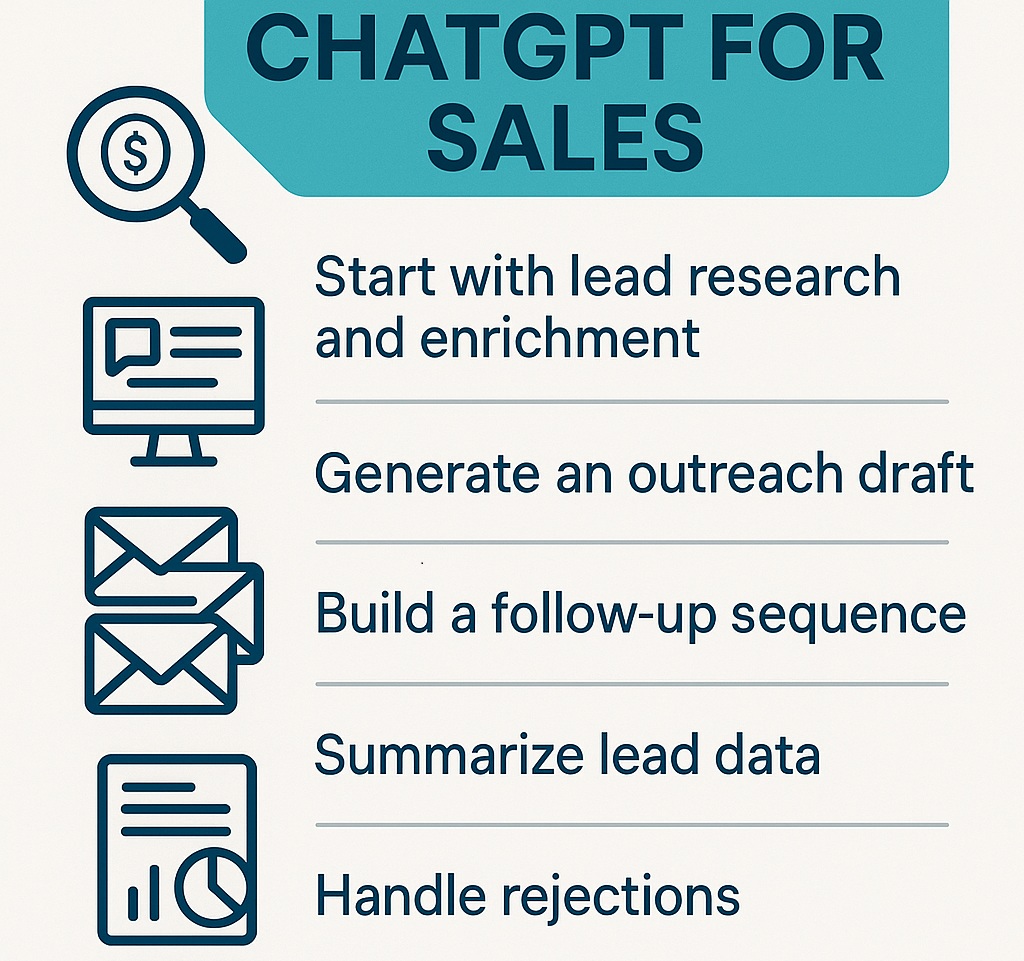
To use ChatGPT for sales prospecting, try this straightforward roadmap:
Start with lead research and enrichment – Begin by feeding ChatGPT basic public data (company name, website, industry, etc.) and ask it to compile a summary. What does the company do? How big are they? Any recent developments of note, or key decision-makers to be aware of? ChatGPT’s search functionalities can draft out a quick “dossier” before outreach ever begins.
Generate an outreach draft – After identifying a promising prospect, prompt ChatGPT to write a cold email or LinkedIn message tailored to the contact or account. Be sure to review and touch up messages before sending them: AI has a tendency to “hallucinate” false claims and statistics.
Build a follow-up sequence – As a preemptive measure, you may consider generating additional follow-up messages. If available, ChatGPT’s “Tasks” or reminder features can also help you set notifications for when it’s time to follow up on a certain account.
Summarize lead data – Copy-paste any piecemeal data points to distill and structure out the essentials. ChatGPT’s memory functionality can even retain specific details for you to reference later, allowing you to ask simple questions (“What are this prospect’s recent accomplishments, again?”) instead of digging back through old chats.
Handle rejections – Negative replies are part of the job, but tactful responses to objections aren’t always easy. ChatGPT is ideal for drafting calm, respectful replies to the “not right now” or tenser messages. This removes emotion from the equation, helping reps avoid burning any bridges with prospects that might re-engage later.
Bear in mind that, while its responses may feel “human”, ChatGPT is primarily a large language model (LLM). In other words, it seeks to mirror your input, and therefore may present a slanted view of data.
As such, it may not be ideal to use ChatGPT to prioritize or disqualify leads, or to consult with leadit regarding deeper interests, pain points, or priorities in a business.
ChatGPT Prompt Examples for Prospecting
There’s a common mantra in AI circles: garbage in, garbage out. In other words, the quality of prompts you feed into ChatGPT directly impacts the quality of its output.
With that in mind, consider some ready-to-use prompts for sales teams to get the most out of ChatGPT:
Lead research prompt – “Give me a concise company profile for [company]. Include what they do, approximate size, industry, recent public news or announcements, and potential pain points for a vendor in [your category].”
Outreach draft prompt – “Write a friendly but professional cold outreach email to [name] at [company]. They operate in [industry]. Search for and open with a recent company milestone, then position our product/service as helping solve [pain point]. End with a soft call-to-action to schedule a discovery call.”
Follow-up sequences prompt – “Write a polite follow-up email to [name]. Previous email sent [X] days ago with no response. Reiterate our value proposition with a different angle, including a quick case study or relevant statistic.” (Again, ensure you feed ChatGPT relevant context for your company to fuel these messages.)
Summarizing lead data prompt – “Here is raw lead data: [paste in any notes]. Organize and summarize all information into a clean output, and save this information as “Account 1” for future reference.”
Rejection handling prompt – “Write a polite reply to a prospect who rejected our offer. [Reference them if you have memory features enabled.] Keep doors open, offer relevant value if possible (such as a free resource or insight), and propose a later check-in without being pushy.”
Note that ChatGPT’s dedicated page for sales teams (the ChatGPT Business Plan) rotates real-world prompts for additional inspiration.
Benefits of Using ChatGPT in Sales
Reps and teams consistently note several benefits of using ChatGPT in sales workflows. Namely, ChatGPT:
Improves message quality and consistency since AI drafts are logically structured, professional, and free from spelling or grammar errors.
Breaks through bottlenecks by handling in seconds what would take a human rep hours.
Helps with creative ideation, acting as both a sounding board and data storage tool for complex accounts.
Empowers personalization at scale with plug-and-play templates and promptable outputs tailored to key accounts.
When multiplied across an entire team, the benefits of using ChatGPT for sales prospecting only compound.
As mentioned earlier, ChatGPT (or any other AI program) cannot promise absolute accuracy—or privacy. For this reason, it’s crucial to be mindful of the following caveats:
Accuracy – Every ChatGPT session comes with a fine-print message: “ChatGPT can make mistakes.” As noted earlier, hallucinations remain a major problem, especially for statistics. Always fact-check before sending such information to prospects, as invalid claims could easily damage credibility.
Data privacy and compliance – When using public or third-party data for outreach, ensure you comply with relevant privacy laws and data regulations, particularly in regards to opt-outs and data sharing. Since ChatGPT data may be used to train the model (depending on your plan), it’s important to be mindful of the information you share.
Aside from these primary concerns, there are also more “minor” considerations to be aware of:
Over-automation – Relying too heavily on AI, particularly for written content, risks messages falling flat due to their inherent “robotic” tone and specific tells. Effective sales are built on empathy, which is beyond the capability of any chatbot.
Dependency – Some users have reported an overreliance on ChatGPT to the point that their work grinds to a standstill when it’s not available. While AI is a powerful tool, sales teams must be mindful not to outsource their creativity or empathy.
The bottom line? ChatGPT can be a powerful tool, but only when exercised as just that: a tool in the hands of a distinctly human user.
The Future of AI-Assisted Prospecting
Garnter makes a bold prediction: 95% of seller research workflows will begin with AI by 2027. Whether that’s true or not, what is certain is that AI-powered tools continue to emerge as the ideal complement to ChatGPT.
For example, imagine a workflow where AI:
Pulls a call-ready list of ICP-focused leads with just a few clicks
Integrates directly with your CRM and favorite sales tools to minimize friction and task-swapping
Continually enriches every lead with up-to-date firmographics, intent signals, company news, and other real-time insights
The real kicker? That workflow is already here—with Seamless.AI.
With generative AI tools like ChatGPT—and data-accuracy platforms like Seamless.AI to feed them—sales prospecting workflows have never been smoother.
As with every new advancement, what matters is adapting to its limitations while playing into its strengths. And AI has many, many strengths.
That is especially true of Seamless.AI.
With over 1.3 billion contacts, easy CRM integration, and natural synergy with tools like ChatGPT, Seamless.AI is far more than “just another AI tool.” It’s the backbone of next-generation sales prospecting.
Sales intelligence and prospecting expert with years of experience to help sales teams grow and hit quota. Voted one of the top startups in America and rated as the highest software in Customer Satisfaction from G2 best software awards in 2025. Join our Reddit community for more product updates and sales tips. https://www.reddit.com/r/Seamless_AI/