5 Proven Sales Prospecting Strategies to Grow Pipeline
Seamless Team
January 8, 2026
Book calls. Drive deals. Feed the funnel.
Every sales rep knows the routine, along with that stomach-dropping feeling of disappointment that follows when the funnel goes un-fed, and outreach doesn’t seem to stick.
It’s not just you; Forrester research shows that a staggering 86% of B2B purchases stalled during the buying process in 2024 (Forrester). Clearly, landing deals is getting tougher for everyone.
2025 B2B deals stat
Why is it getting so hard to close these days? The problem may lie with sales prospecting strategies: the “how” and “why” behind your research, outreach, and day-to-day execution.
Even though the numbers seem grim, there’s a silver lining in all of this. The good news? Breaking through is totally possible. Below, we’ll discuss five strategies that prove it.
When you put this theory into practice, you’re matching real businesses to your ideal customer profile (ICP), figuring out who makes their purchase decisions, and then reaching out to those individuals to gauge interest.
It all starts with a strong list, which is at the core of an effective prospecting strategy.
Why Strong Prospecting Strategies Matter
If your team doesn’t have effective prospecting, your pipeline essentially relies on random luck, hoping others will find you (amidst a sea of competition).
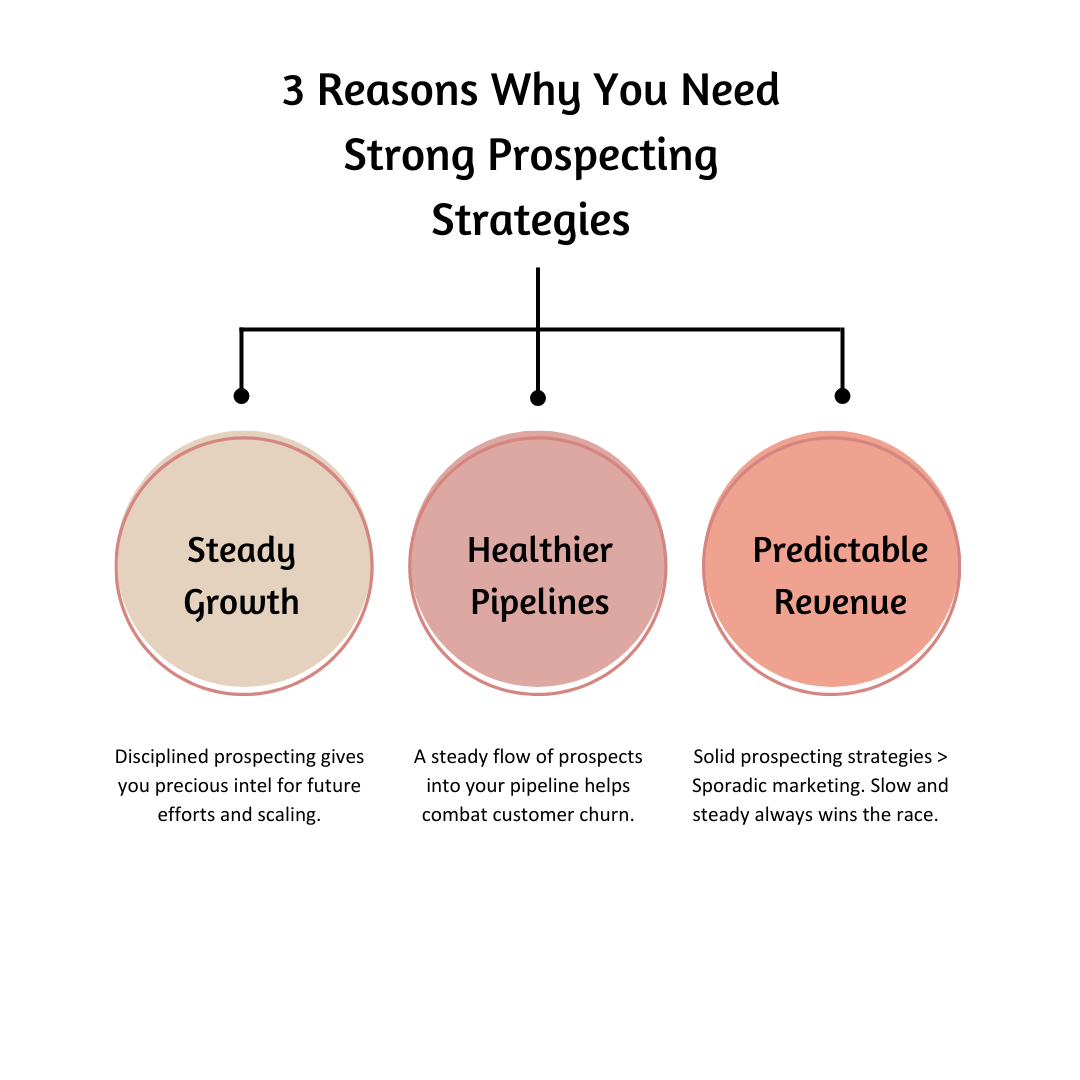
This is why your team needs strong prospecting strategies
In contrast, strong sales prospecting strategies give you:
Steady growth – Disciplined prospecting keeps the funnel fed, helping you see where deals sit and where they tend to get stuck. This information, in turn, can help you refine future efforts and scale.
Healthier pipelines – A steady “flow” of prospects helps combat the customer churn and stagnation that all industries face. Solid prospecting strategies maintain consistent pipelines, not clogged ones.
Predictable revenue – Rather than rely on income spikes from sporadic marketing campaigns, the “scientific” approach of a solid prospecting strategy delivers measurable results, providing clear insights to predict future revenue.
A strong sales prospecting strategy is a huge competitive differentiator. The more efficiently you can pitch (and ideally, convert) a prospect, the higher your return on every dollar and hour spent acquiring them.
Hopefully, we’ve made it clear how important strong prospecting is, and you’re now a believer. Now it’s time to break down five practical strategies that will help you drive the execution.
#1. Ensure Multichannel Outreach
Research shows that a multichannel approach actually works. The more customers interact with you over these channels, the more likely they are to convert (Frontiers).
And this makes sense; the modern B2B buyer’s journey is not a linear one. So, building your sales prospecting strategies across channels, such as email, phone, LinkedIn, and SMS, naturally drives better results than going all in on a single channel.
#2. Leverage Value-Based Messaging
Every sales channel is saturated with competitors, which means if you want to set yourself apart from the rest, your B2B sales prospecting strategies must shift towards value-based messaging. This approach is defined by:
Deep research on the prospect
Outreach tailored specifically to their needs
Focus on providing value upfront
When your messaging is specific, useful, and tailored, prospects are more inclined to believe the same is true of your product.
#3. Warm Up Cold Leads via Social Selling
Social selling, or using social networks and social media as a sales channel, is not just limited to consumer shopping.
Consider LinkedIn, one of the world’s largest professional social networks with over 1 billion members (LinkedIn). That translates to countless potential leads just waiting to be tapped into.
But before you drop your elevator pitch, focus on strategic networking.
Warming up cold leads on social media
Strategic networking can engage these leads so you become a trusted voice before pitching any services. For example, prospecting teams might:
Create and post value-driven content for their ICP
Engage with promising accounts’ content via commenting
Build up “social capital” and authority over time before diving into the pitch
Artful prospecting is less about the pitch and more about connecting on a human level, an important distinction as AI automates more and more of our daily lives.
The 70/30 rule states that prospects should talk about 70% of the time, while you talk only 30%, focusing on sharp questions and deep, active listening (Forbes).
Ultimately, for discovery calls, reps should focus on the prospect, not their pitch.
#5. Frame Your Prospecting Around the 5 Ps
The 5 p's of prospecting
Solid frameworks deliver consistent results, and no framework is more powerful in sales prospecting than the “5 Ps”. These are:
Purpose – Know why you’re reaching out and the outcome you want
Preparation – Research the account, the person, and their context
Personalization – Ground messaging in their needs, not your features
Perseverance – Follow up thoroughly and remain positive
Practice – Review past calls, refine your messaging, and grow over time
Used well, these principles act as guiding guardrails to keep prospecting quality high even during busy seasons.
How to Identify the Right Prospects
The best pitch only works if you have the right person on the other end. That’s why, as noted earlier, building a list is crucial to success.
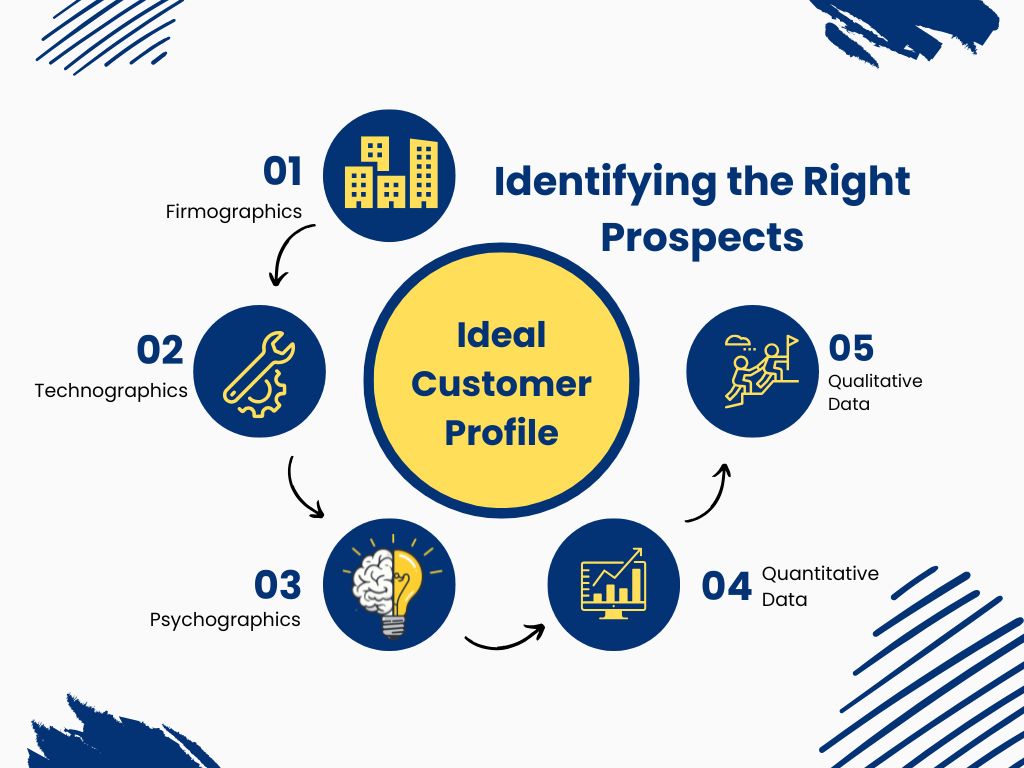
How to build your ideal customer profile
Effective list-building starts by proving, with data, who is most likely to buy and expand: In other words, your ideal customer profile (ICP). Most modern teams define ICPs through (Gartner):
Firmographics – These are the specifics of the business itself, such as headcount, revenue, industry, location, and business model.
Technographics – This refers to the tech ecosystem ideal customers live in, including what they use to manage customer relationships and enterprise data.
Psychographics – This is your ideal customer’s approach and attitude toward technology. Do they advocate for sustainability? What’s their stance on AI?
Quantitative data – This refers to historical context on what business they’ve had with you, from average deal size and length of tenure to which channel you acquired them through.
Qualitative data – This refers to live feedback from reps who’ve dealt with the customers.
Seamless.AI offers several search filters that allow you to put together a detailed ICP. Whether you’re looking for firmographic data like company revenue and employee size, or technographic data on the top tools your best customers use, this platform has you covered.
Remember the goal is to map out patterns and identify your most profitable, loyal customers. Where are they located? What’s their tech stack? What deals did they close, and why?
Ultimately, such data narrows your ICP from “mid-market SaaS companies” to very specific orgs your sales teams can target.
Tools That Support Prospecting Success
For any strategy to be successful, you need a solid foundation of people and processes. The right tools support both, ensuring reps make the best use of their time without sacrificing lead accuracy and quality.
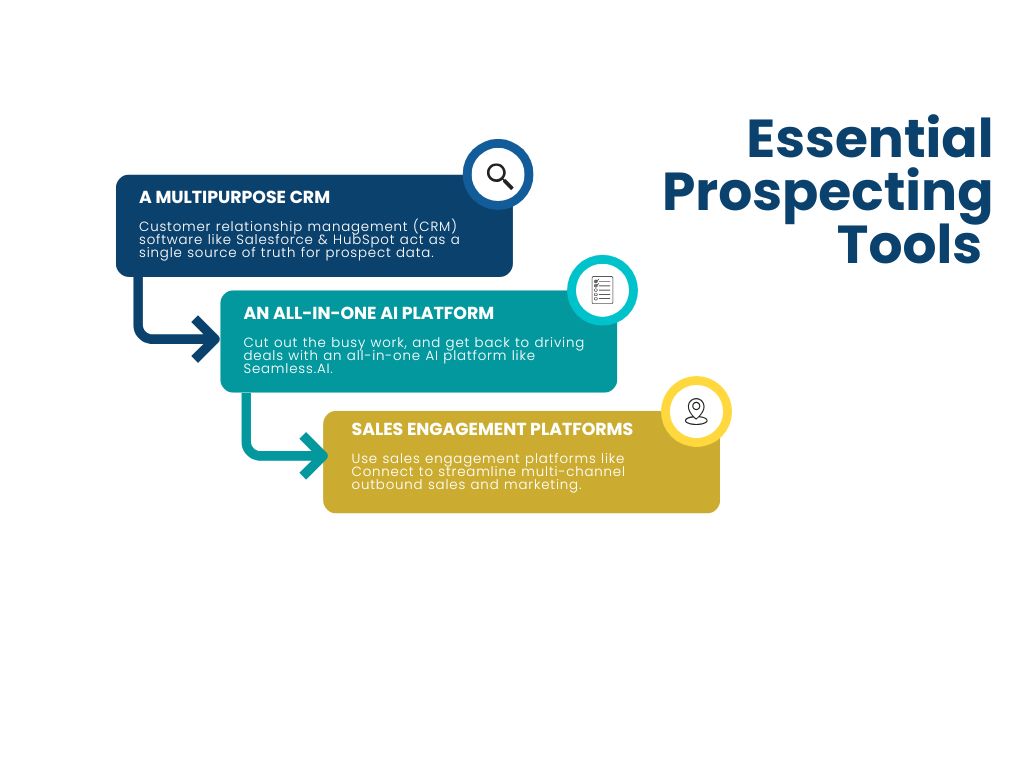
Our top 3 super essential prospecting tools
To that end, aim to incorporate tools such as:
A versatile CRM – Customer relationship management (CRM) software is your foundational “source of truth” for all data related to potential prospects. Since strong pipeline management hinges on accuracy and dependability, well-established tools such as Salesforce and HubSpot present ideal options.
AI-powered platforms – AI assistance acts as a force multiplier for your reps, saving them the time and headspace they need to get more done with less. For example, Seamless.AI is an AI-powered sales intelligence platform that uses comprehensive artificial intelligence to find, verify, and validate contact data (emails, phone numbers, firmographics, and more) in real-time across 1.3B+ contacts. This way you don’t have to waste time on pipeline generation and can instead focus on building relationships with potential clients.
Sales engagement platforms – As noted previously, multichannel prospecting is key if you’re looking to drive better results. Sales engagement platforms like Seamless.AI Connect can help coordinate multichannel sequences, such as over email, phone, and social media, to run strategic (rather than ad-hoc) outreach.
Strategic prospecting doesn’t stop at the execution. It requires tracking key performance metrics—the right metrics.
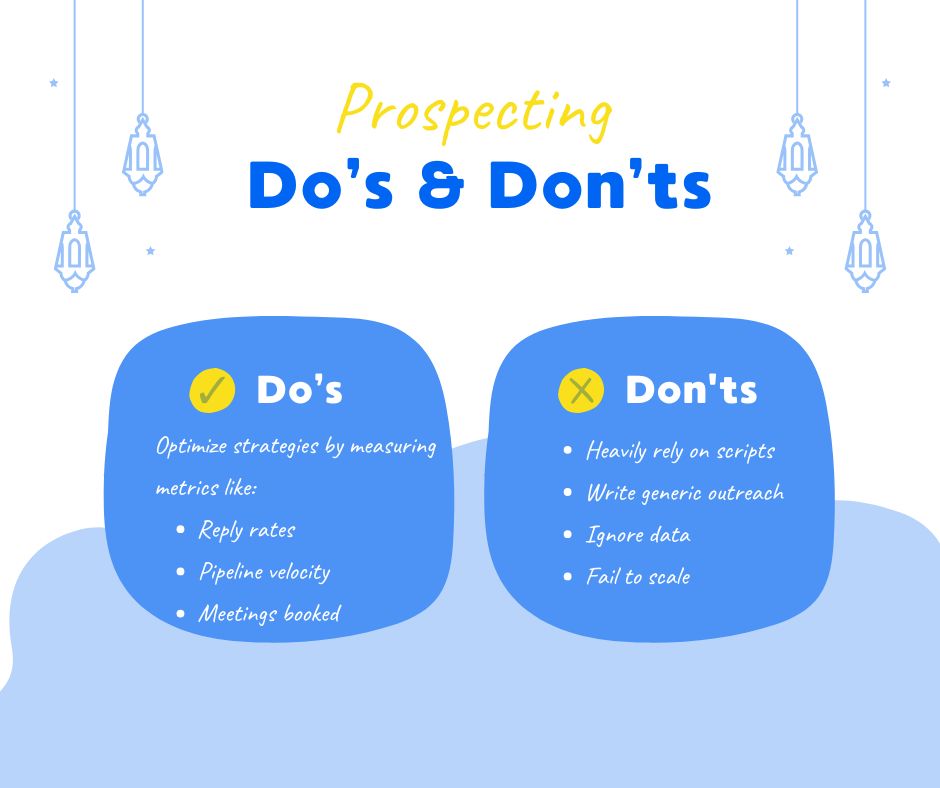
The do's and don'ts of sales prospecting
To truly refine your strategy, prioritize metrics such as:
Response and positive reply rates – Are messages striking a chord with your audience?
Pipeline velocity – How quickly are opportunities becoming closed deals?
Meetings booked – A clean early indicator of a successful strategy.
These meaningful metrics will help you gauge whether your ICP, messaging, and channels are working in sync, as well as which areas may need improvement.
Common Mistakes to Avoid in Sales Prospecting
Avoidable mistakes can weigh down even the best strategies. Particularly in an AI world, sales reps must take extra care to avoid:
Over-relying on scripts, which can tank a pitch if you don’t inject your own personality and instead deliver your lines like a robot
Generic outreach, which pales compared to deeply researched, tailored messaging
Ignoring data signals that may be pointing toward strategic improvements
Failing to scale, whether by neglecting AI-powered tools or failing to automate those repetitive (time-drainer) tasks
That last one is especially critical.
As prospecting channels get more and more crowded, teams need every advantage to maintain a competitive edge.
Build Consistent Pipeline Growth with Seamless.AI
It’s true that landing deals are getting tougher. AI has revolutionized sales prospecting strategies, fueling explosive growth. At the same time, AI has also raised the bar for personalization, timing, and making genuine human connections.
One tool uniquely positioned at the intersection of both these truths? Seamless.AI.
Built specifically for sales prospecting teams, Seamless.AI automates the grittiest parts of the job, like finding real-time verified contact information and qualified leads, list-building, and data enrichment.
With a powerful search engine adaptable to your business needs, Seamless.AI automates prospecting and buys back selling time, so teams are empowered with the information they need to do what they do best: cultivate relationships that drive revenue.
And when you’re able to do your best, our team at Seamless.AI is able to do what we do best: Get you ready, energized, and equipped to win, whatever it takes.
Sales intelligence and prospecting expert with years of experience to help sales teams grow and hit quota. Voted one of the top startups in America and rated as the highest software in Customer Satisfaction from G2 best software awards in 2025. Join our Reddit community for more product updates and sales tips. https://www.reddit.com/r/Seamless_AI/


.jpg)