As a sales pro, you’ve likely felt the tension between prospecting and lead generation, even though the two are usually referenced as if they are interchangeable.
Lead generation always focuses on attracting interest at scale: capturing names, emails, and signals of intent.
While sales prospecting is the next stage. It’s the deliberate work of identifying the right accounts, reaching out with a relevant, value-driven message, and turning potential into pipeline.
While lead generation and prospecting are distinctive, many teams try to solve a prospecting problem with lead-generation tactics, or expect prospecting to carry the full weight of pipeline creation, which creates friction that wastes time.
In this article, we'll look at the difference between sales prospecting vs lead generation, and how smart teams use the two together to close more consistently.
What Is the Difference Between Sales Prospecting and Lead Generation?
The simplest way to think about the difference is this: Lead generation creates opportunity, while sales prospecting converts that opportunity into action. Both are essential, but they solve very different problems in the revenue engine.
.jpg)
- Lead generation sits at the top of the funnel. The priority with lead generation is to attract interest and capture signals at scale. This includes inbound efforts like content, ads, events, referrals, and website conversions. The output of lead generation is volume and awareness: names, emails, companies, and early intent. At this stage, most leads just have potential, but they aren’t usually ready yet to convert and buy.
- Sales prospecting begins once the door is open. It’s outbound and deliberate. Prospecting involves researching accounts, identifying decision-makers, personalizing outreach, and initiating direct conversations that move deals forward. The goal here is always progress and getting the ball rolling towards that closed deal.
Consider a real-world scenario: A marketing campaign generates 500 leads. Sales doesn’t call all 500. Instead, reps prospect into the subset that fits the ICP, shows stronger intent, or aligns with active buying signals. Then, they reach out with context.
When the roles between lead generation and sales prospecting blur, teams struggle.
Some expect lead generation to deliver only “sales-ready” leads. Others expect prospecting to compensate for weak top-of-funnel activity. The result is reps chasing unqualified leads and a pipeline that looks deceptively full but doesn’t convert.
How Lead Generation Works in the Sales Funnel
Most inbound lead generation efforts follow a familiar path.
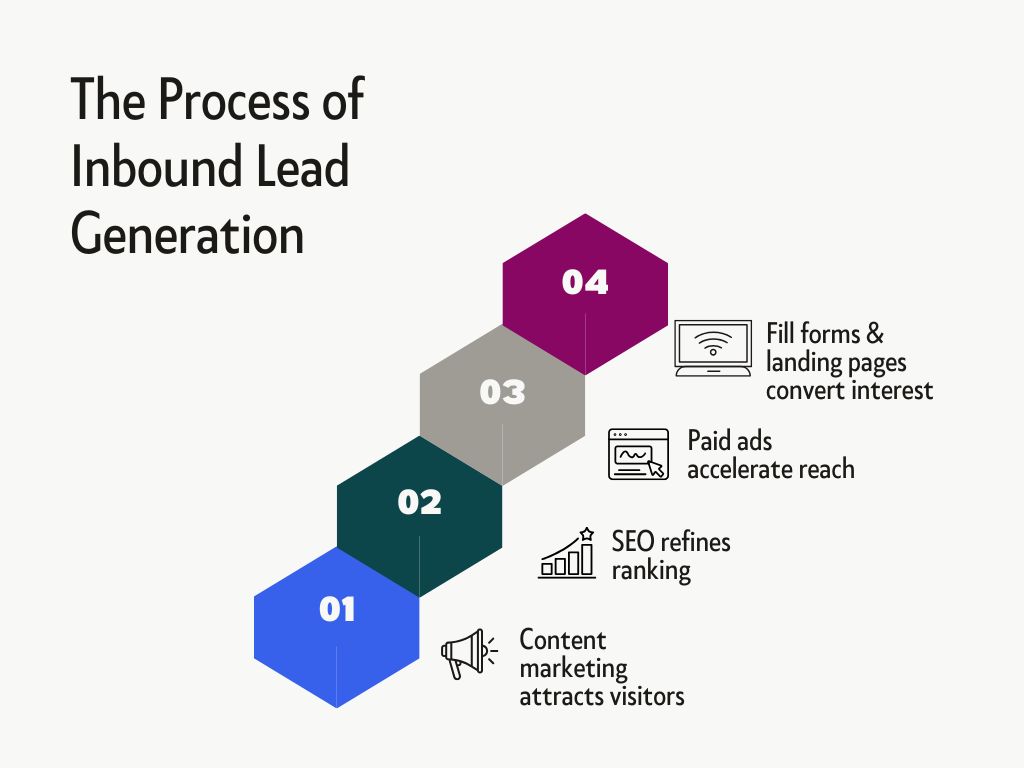
- Content marketing attracts visitors through blog posts, guides, and case studies.
- SEO ensures content appears when prospects are actively researching problems.
- Paid ads accelerate reach by putting offers in front of targeted audiences.
- Forms and landing pages then convert that interest into identifiable leads.
The output of lead generation is volume with context. It feeds the funnel, but it doesn’t close deals on its own.
How Sales Prospecting Works in Practice
Sales prospecting begins once there’s interest, or when teams deliberately want to create it.
In practice, prospecting that’s efficient and drives results should always be hands-on and targeted. Reps research accounts, identify decision-makers, and reach out directly with personalized messages. Cold emails, LinkedIn outreach, discovery calls, and follow-ups all fall under this motion.
Consider a sales development representative (SDR) targeting mid-market SaaS companies. Instead of waiting for inbound leads, they identify ICP-fit accounts, find the right contacts, reference recent company activity, and start a conversation.
Why Both Prospecting and Lead Generation Matter
Revenue growth is the bright, shiny goal every team is after, but achieving it depends on balance.
Lead generation ensures there’s always interest entering the funnel. Prospecting ensures that interest doesn’t sit idle. Without lead generation, sales teams burn time chasing cold accounts. Without prospecting, inbound leads go stale or get lost.
When the two work together, the pipeline becomes healthier and more predictable.
When to Prioritize Prospecting vs Lead Generation
.jpg)
Inbound lead generation is often the priority when:
- You have strong brand awareness
- Demand already exists in your market
- You’re launching new content, products, or campaigns
Outbound prospecting tends to drive faster results when:
- You’re entering a new market or segment
- Inbound volume is low or inconsistent
- You need a pipeline quickly to hit near-term targets
Most high-performing teams invest in inbound for sustainability and prospecting for speed.
Tools That Support Both Processes
Modern sales teams rely on tools, like Seamless, that remove friction from both motions.
Seamless helps with the hardest part of prospecting and lead generation: finding accurate, real-time B2B contact data. It supports outbound research while strengthening inbound follow-up with better enrichment and targeting.
Meanwhile, as a base-layer tool, ChatGPT or our AI Assistant can support messaging and preparation, helping reps draft outreach, summarize research, and personalize communication at scale (ScienceDirect).
Common Gaps Between Prospecting and Lead Gen Teams
If your team struggles with lead generation and sales prospecting, the issue is likely misalignment with data, process, messaging, or siloed workflows.
Unclear Qualification Criteria
One major pain point when it comes to lead generation and sales prospecting is disagreement over what makes a quality lead. Marketing may define a “good lead” by engagement, while sales defines it by fit. If marketing and sales can’t get on the same page, and if there’s no clear shared criteria, teams optimize for different outcomes. The result is leads that look strong on paper but stall once outreach begins.
Messy Handoff Processes
Speaking of alignment and getting on the same page, if it’s not clear who owns what, leads will sit untouched and collect dust. A form fill may trigger an alert, but if no one knows who should act or when, that lead is as good as lost, and you DON’T want that.
Inconsistent Messaging
When marketing sets one narrative, but sales delivers another, prospects feel the disconnect immediately. And if the experience you create for prospects is inconsistent— if what sounded compelling in an ad or a social media post doesn’t align with the messaging when a buyer hops on a call with a rep– you can kiss that opportunity goodbye.
Siloed Tools and Data
Prospecting and lead generation go hand in hand, so why keep them siloed? If prospecting lives in one system and lead generation in another, teams lose visibility into the overall pipeline, so finding your sales opportunities can get tricky.
Best Practices for Combining Prospecting and Lead Generation
High-performing teams close the gap by treating prospecting and lead generation as two motions inside one system.

Here’s how your team can do the same:
- Unify the ICP – Both teams should work from the same definition of an ideal customer (ScienceDirect).
- Build shared scoring models – Lead scoring should reflect both engagement and fit, ensuring scoring that prioritizes the right leads.
- Use integrated tools – When data flows efficiently between systems, teams stay aligned.
- Set cross-team SLAs – Define expectations clearly. How fast should sales follow up on an MQL? When should a lead be recycled? SLAs turn alignment into action.
Align Prospecting + Lead Gen With Seamless
Prospecting and lead generation work best when they’re not competing for attention, but reinforcing the same motion. When both teams operate from shared signals and trusted data, the handoff feels natural.
Seamless helps support that alignment and top-of-funnel search capabilities by strengthening the foundation on which both motions rely. With verified, real-time contact data, buyer intent insights, and automated discovery:
- Instead of shooting in the dark, marketing can get insights that help identify high-intent prospects.
- Sales knows exactly who to engage.
As a direct result, teams that use Seamless shorten their sales cycles, increase conversion, rates, and expand their market reach.
Here at Seamless, it’s our mission to remove the friction that slows revenue teams down. When prospecting and lead gen pull in the same direction marketing and sales become unstoppable like the Avengers, growth becomes more predictable, and execution becomes much easier.
Book a demo and find out how Seamless can align your prospecting and lead generation today.
Sources:
ScienceDirect. ChatGPT: A comprehensive review on background, applications, key challenges, bias, ethics, limitations and future scope. https://www.sciencedirect.com/science/article/pii/S266734522300024X
ScienceDirect. Hunting for new customers: Assessing the drivers of effective salesperson prospecting and conversion. https://www.sciencedirect.com/science/article/abs/pii/S0148296322004313