As a salesperson, you've probably heard this before: Activity drives opportunity.
The more calls you make and the more appointments you book, the better, right?
Well, not necessarily. Anyone who’s worried about quota knows activity alone isn’t enough. Generic calls and emails without context may fall flat, wasting both your time and effort.
That’s why sales prospecting methods have evolved. Cold lists and volume-based outreach used to be the moves, but now it’s all about precision: finding the right accounts, reaching the right people, and starting conversations that actually go somewhere.
With AI now embedded into modern workflows, prospecting has shifted from a numbers game to a strategic discipline.
Let’s look at today’s most effective sales prospecting methods for lead gen and how teams are using smarter approaches to turn outreach into momentum.
What Are Sales Prospecting Methods?
Sales prospecting methods are the structured approaches teams use to identify potential buyers, research their needs, and start meaningful conversations that lead to qualified opportunities.
They define how reps move from “who might buy” to “who is actively searching and evaluating.”
FYI: Prospecting isn't all about cold emails and calls
Some teams rely heavily on outbound lead discovery. Others prioritize inbound marketing demand. But a lot of times with inbound and outbound, it isn’t an either/or. In fact, the most high-performing organizations blend both.
What really separates effective prospecting from busywork is intention (ScienceDirect). Strong methods are rooted in a clear ICP, supported by accurate data, and reinforced by consistent workflows. Reps also know which accounts to pursue and how to approach them.
AI In Modern Sales Prospecting
Modern prospecting also depends on having the right tools. AI now supports list building, data enrichment, contact prioritization, and personalized messaging, giving back sellers more time in the day to operate with real-time insights instead of static spreadsheets.
In other words, while the rep still owns the method, the execution is increasingly powered by automation.
At their core, sales prospecting methods provide a repeatable, scalable way to create a pipeline. They bring structure to discovery and discipline to outreach.
Why Sales Prospecting Methods Matter for Lead Generation
Lead generation creates interest, but prospecting determines whether that interest can turn into revenue.
Without strong prospecting methods, lead gen volume quickly turns into noise.
Is your pipeline is dry? Try fine-tuning those prospecting strategies
First, it raises pipeline quality. When reps target accounts that match their ICP and prioritize based on intent data, fewer resources are wasted on low-probability deals.
Second, it shortens sales cycles. Contextual outreach and timely follow-ups move prospects through qualification faster.
Third, it creates predictability. When prospecting is systematic, the pipeline stops depending on individual effort and starts running on process. Teams can forecast with confidence because opportunity creation follows clear patterns.
Consider two SDR teams with identical inbound volume. One works every lead with the same strategies.
While the other segments by role, filters by firmographics, and prioritizes engagement signals.
Over time, the second team consistently produces more qualified meetings with fewer touches (IBM).
That’s the difference methods make.
Ultimately, strong prospecting doesn’t just support lead generation; it converts demand into durable growth.
Types of Sales Prospecting Methods
Once teams establish clear prospecting fundamentals, the next step is choosing the right methods for how they go to market. Most modern sales organizations don’t rely on a single approach. Instead, they combine outbound, inbound, and digital tactics to create a consistent pipeline from multiple angles.
Outbound Prospecting Methods
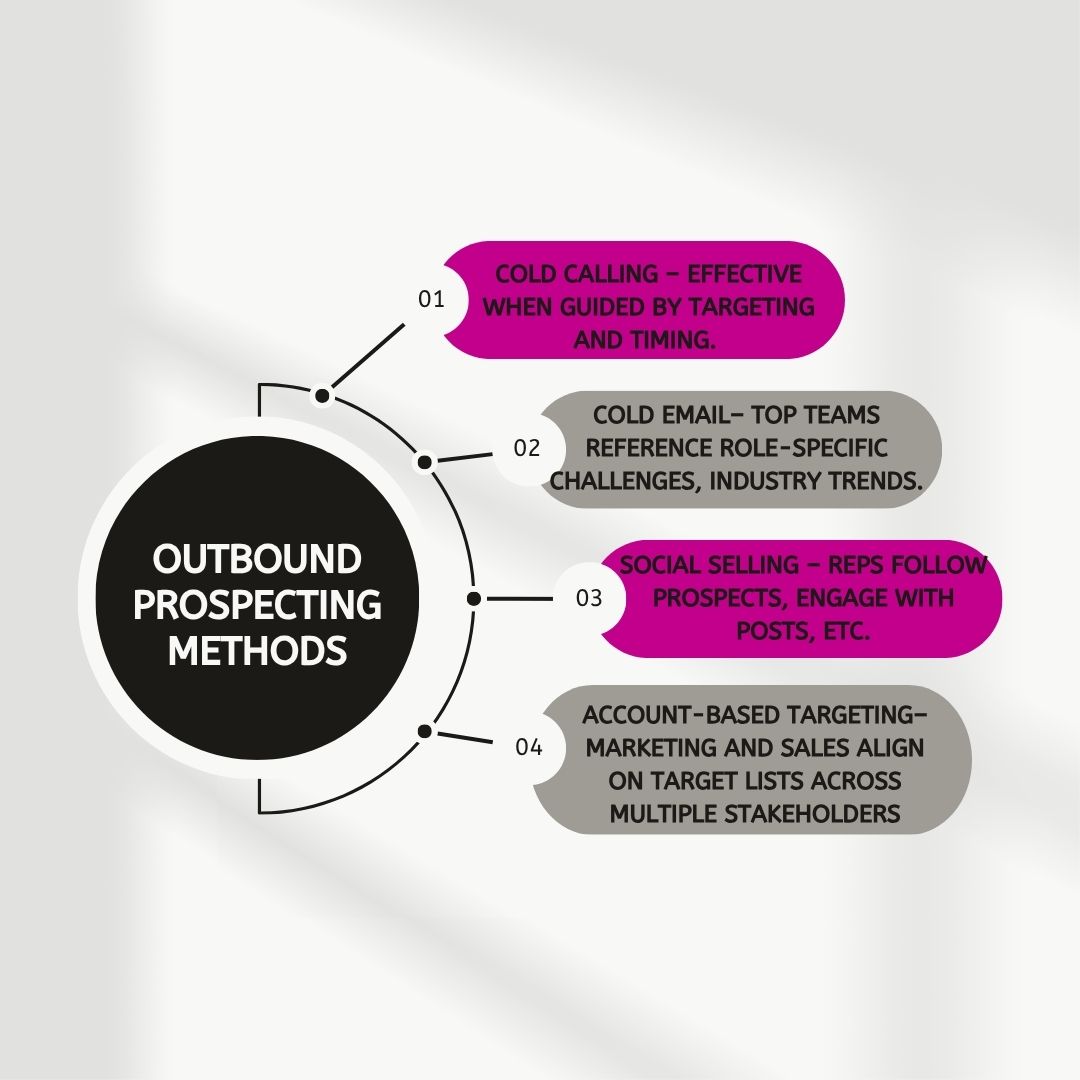
Outbound prospecting is proactive. Reps initiate contact with accounts that fit their ICP, rather than waiting for interest to surface. Methods include:
4 outbound prospecting strategies that actually work
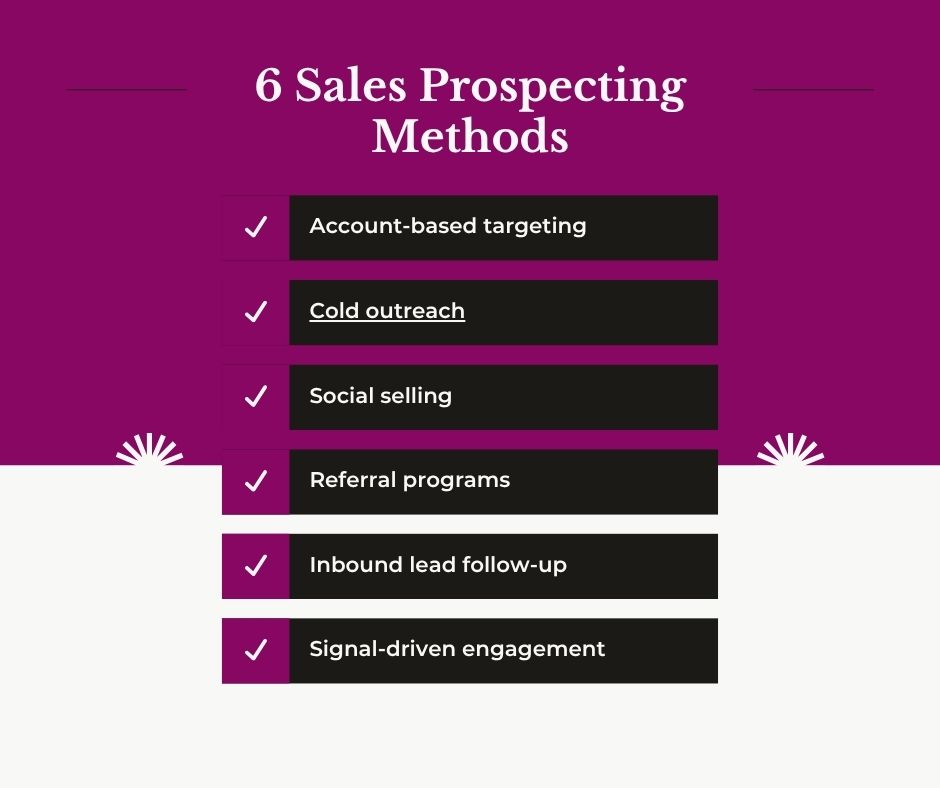
Cold calling – Despite the dip in popularity, Cold calling is still an effective approach as long as your targeting and timing are on point. For instance, a rep calling accounts that show hiring activity or recent funding will have a very different conversation than one dialing a static list.
Cold emailing – The cold emailing method works best when the messaging reflects real context. So instead of generic pitches, top teams reference role-specific challenges, recent company activity, or known industry trends.
Social selling – Social selling turns platforms like LinkedIn into research and engagement channels. Reps follow prospects, engage with posts, and start conversations that feel natural rather than transactional.
Account-based outreach – This focuses effort on a defined set of high-value accounts. Marketing and sales align on target lists, while reps personalize outreach across multiple stakeholders inside each organization (McKinsey & Company).
Outbound prospecting creates opportunities where none existed before. When supported by accurate data and intent signals, it becomes even more precise.
Inbound Prospecting Methods
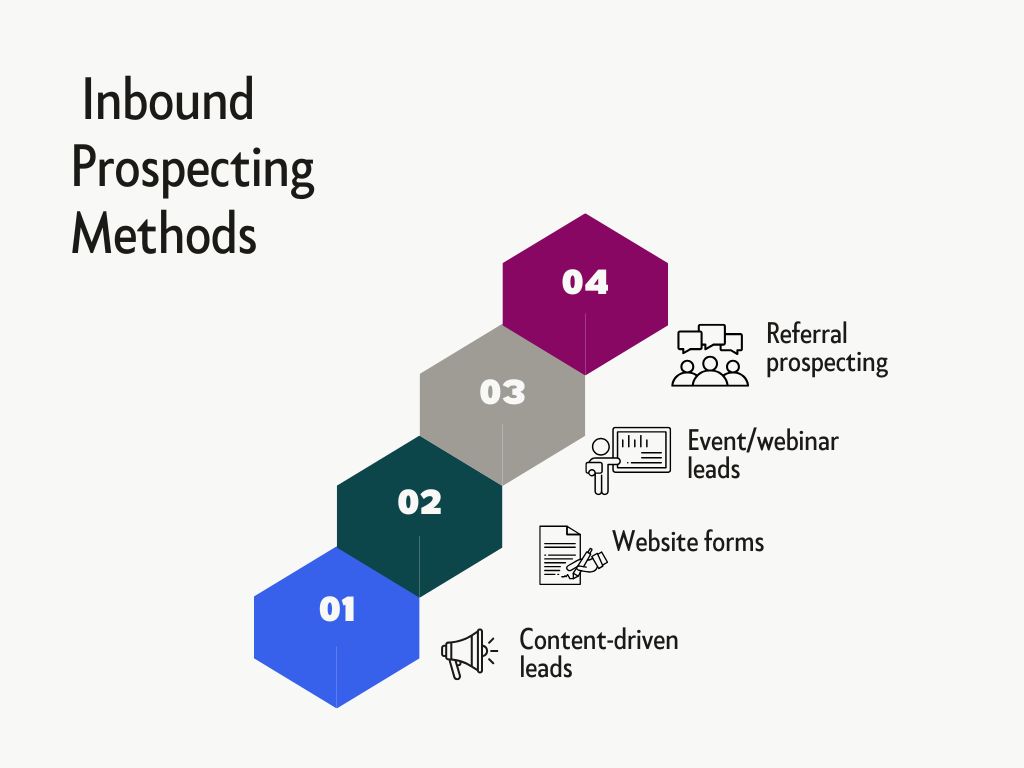
Inbound prospecting starts with interest and turns it into a pipeline. Here’s how:
Here are 4 prospecting methods that drive inbound leads
Content-driven leads – These arrive through blogs, guides, and gated resources. Reps qualify these contacts based on engagement depth and firmographics.
Website forms – These capture demo requests and contact submissions. Speed matters here—fast follow-up often determines whether a rep can maintain momentum.
Event and webinar leads – These provide warm entry points. If a rep can reference an attended session, they can increase relevance.
Referral prospecting – This method leverages existing relationships. These leads typically convert faster because trust already exists.
Inbound lead gen methods work best when sales respond quickly and prioritize leads based on intent.
Digital Sales Prospecting Methods
Digital prospecting brings structure and scale to both inbound and outbound motions.
Do you prefer a digital approach? Test out these prospecting methods
LinkedIn prospecting supports research, engagement, and direct messaging.
Email sequences enable consistent multi-touch outreach without manual tracking.
CRM-based prospecting centralizes contact history, engagement signals, and pipeline status.
Together, these tools turn prospecting into a repeatable workflow instead of a scattered effort.
Sales Prospecting Methods for Personalization at Scale
Personalization no longer means writing every message from scratch.
Teams can use segmentation to group prospects by role, industry, or company size. Then:
Data enrichment adds context like recent funding or leadership changes.
Messaging frameworks provide structure for tailoring outreach without slowing execution.
A rep might send one version of an email to finance leaders and another to operations: same value proposition, different emphasis. That’s personalization at scale.
Sales Prospecting Methods for Pipeline Acceleration
Acceleration comes from focus and timing.
Prioritization ensures reps start with accounts that show buying signals. Multi-touch cadences keep prospects engaged across email, phone, and social. Meanwhile, fast follow-ups prevent warm leads from going cold.
Instead of working on everything equally, high-performing teams work on the right opportunities first.
When these methods are combined, prospecting stops being a series of disconnected activities and instead becomes a system designed to move qualified buyers through the funnel faster and with intent.
Best Practices for Effective Sales Prospecting Methods
For stronger prospecting, all you need is to form repeatable habits.
If your team isn't running these habits, you're doing your prospecting all wrong
Test your messaging – High-performing teams constantly iterate on subject lines, openers, and calls to action. Small changes compound when applied across hundreds of touches.
Keep your data clean – Regular data enrichment and deduplication ensure reps start with accurate inputs instead of fixing records mid-flight.
Align sales and marketing – When both teams work from the same ICP and qualification criteria, messaging stays consistent from first touch to discovery call.
Follow up consistently – Most deals don’t convert on the first interaction. Structured cadences across email, phone, and social keep conversations moving without relying on memory.
✅ Pro tip: Prospecting works best when these practices are built into the workflow, not left to individual preference.
Common Mistakes in Sales Prospecting
Most prospecting breakdowns don’t come from a lack of effort—they come from misaligned execution.
If you want your sales prospecting to fall flat, run these bad habits
Generic outreach is the fastest way to disappear into an inbox. When messages lack role-specific context or company relevance, prospects tune out immediately. Use AI Assistant to customize all your outreach in seconds.
Poor targeting compounds the problem. Reps waste hours chasing accounts that don’t match the ICP, lack budget authority, or have no active buying signals. This inflates the pipeline on paper while weakening conversion downstream.
Inconsistent follow-through quietly kills deals. Many prospects require multiple touches before responding. In fact, 80% of sales require at least 5 touches (instantly.ai).
Overreliance on a single channel limits reach. Teams that depend solely on email or cold calls miss prospects who respond better on LinkedIn or via referral introductions. Multi-channel engagement consistently outperforms single-channel outreach (ResearchGate).
Outdated or incomplete data forces reps to troubleshoot instead of sell. Wrong titles, bounced emails, and missing context slow momentum and erode confidence in the system.
In practice, you may see these mistakes surface as slow pipelines and unpredictable results.
Metrics to Track Sales Prospecting Success
Importantly, strong prospecting is measurable. The right metrics will show whether your outreach is turning into real pipeline growth.
6 KPIs to keep track of for successful sales prospecting
Response rate reflects targeting precision and message relevance. Track it by persona and channel to understand what resonates and where adjustments are needed.
Meetings booked measure how effectively engagement becomes conversation. This is often the first indicator of whether prospecting methods are working.
Conversion rate tracks how many meetings turn into qualified opportunities.
Pipeline value connects prospecting directly to revenue potential. It shows whether outreach is filling the funnel with meaningful opportunities or just adding volume.
Pipeline velocity reveals how quickly prospects move from first touch to qualified pipeline.
Sales cycle length highlights how efficiently deals progress once prospecting begins.
Taken together, these metrics provide a full picture of prospecting health, from first contact to revenue impact.
Build a Stronger Pipeline With Proven Sales Prospecting Methods
Sales teams are under more pressure than ever to build a pipeline efficiently. Now, the teams that win aren’t the ones doing the most outreach. Rather, they’re the ones finding the right accounts faster, engaging with relevance, and moving opportunities forward with intent. That’s what modern prospecting looks like.
And when prospecting is powered by accurate data and intelligent workflows, the pipeline transforms from a hope-and-see exercise into a repeatable system.
That’s where Seamless comes in. We help sales teams turn prospecting into execution by delivering verified, real-time contact data and automated discovery that plugs directly into how your reps already work. Put simply, we help you reach the right people at the right moment, with the pitch intelligence needed to start conversations that convert.
Sales intelligence and prospecting expert with years of experience to help sales teams grow and hit quota. Voted one of the top startups in America and rated as the highest software in Customer Satisfaction from G2 best software awards in 2025. Join our Reddit community for more product updates and sales tips. https://www.reddit.com/r/Seamless_AI/