Every deal begins with a lead. Over time (and with ample work), leads become prospects, prospects become customers, and customers bring in revenue.
To the untrained eye, that may seem pretty simple and straightforward. But to anyone with a B2B sales background, it’s no secret that turning leads into customers is hard.
The good news is that lead research and prospecting are becoming simpler each day. Thanks to modern sales automation tools and AI-powered software, moving leads through the sales funnel has never been easier.
Don’t get us wrong, sales is still a time-intensive, human-led skill. However, with some practice and the right tools, you can streamline your pipeline growth and generate more revenue. Discover the latest tools, as well as how to automate lead research and prospecting for B2B sales, in this comprehensive guide.
Why Lead Research and Prospecting Need Automation
Researching leads and prospecting take time. Lots of it.
In fact, salespeople often spend less time selling than they do on manual, administrative tasks. Consider: The average sales professional only dedicates around 28% of their work-week to selling (Salesforce).
This isn’t laziness, sales teams are hustling across all channels. The problem is that too much of their time and effort is going to manual lead research and outreach.

To find and pursue a single potential customer, a sales rep has to:
- Sift through several sites and platforms to find a raw lead
- Collect the lead’s information
- Qualify the lead to see if their needs align
- Research the lead and their company in depth
- Reach out with a personalized, well-crafted message
- Record responses and activity along the way
All this work can take hours, and it still might not amount to a deal.
Multiply this workflow by hundreds of leads, and you can see why lead research and prospecting can benefit from automation.
Fortunately, many of the manual processes involved in these early steps of the sales pipeline can be streamlined with intuitive software and AI, especially because there’s so much repetitive work.
What Automated Lead Research Looks Like
Today’s lead research automation often looks a lot like your everyday interactions with generative AI chatbots. That’s because many automated processes rely on AI to not only complete tasks, but also to “think” for the sales rep.
With that in mind, performing lead research with automated tools can be as simple as asking for what you need. For instance, you might tell your automation software to “generate a list of CFOs of $5M+ companies,” and your virtual assistant will do it. The more explicit and detailed your instructions are, the better your results will be.
Of course, automation isn’t always AI-based. Some automated prospecting still happens the old-fashioned way, where sales reps input parameters, and the tool follows pre-set rules to deliver a spreadsheet or email template.
In any case, what’s happening behind the scenes is largely the same: The machine performs the tasks a sales rep would, automatically, in a fraction of the time. The result? More time for relationship nurturing and selling.
Core Elements of Automated Prospecting
Because lead research and prospecting are long, complex processes, there’s no single tool for automating the entire sales cycle. Instead, you’ll find countless different solutions for speeding up prospecting, each with its own capabilities.
These automation tools can assist with or even take over nearly every aspect of lead research.
Prospect Identification and List Building
Lead research can be one of the most challenging parts of sales, as you’re essentially trying to find needles in a massive haystack. That’s because not just any lead will do the goal is to find ready-to-buy targets that meet your criteria.
The combination of precision and data entry required here makes manual lead research extremely tedious.
However, AI-powered platforms are well-suited to repetitive tasks. Solutions like Autopilot can create enormous lists of possible leads on, well, autopilot.

List-building tools use your ideal customer profile (ICP) to find thousands of leads in the time it would take a human to find one. And these automated processes won’t just deliver names, they’ll uncover all the info you need to make a successful, personalized pitch, including:
- Job titles
- Email addresses
- Cell phone numbers
- Direct dial numbers
- Location
Once you have your list of potential buyers, you can work on bringing them into your sales pipeline. Or, rather, automation can get to work.
Account Intelligence and Data Enrichment
A list of leads defines who you might be talking to. But it doesn’t give you much else to go on.
That’s where automated account intelligence tools come in.

Automated solutions can sort through the leads from a lengthy list and narrow them down to the prospects that are worth your sales team’s time. Using data from CRMs, platforms, and web-based tracking pixels, AI prospecting tools can qualify your leads by learning all about them. Information pulled by these sophisticated solutions can include:
- Firmographic data – This is the lowdown about the lead’s company. The AI will uncover company size, revenue, growth rate, funding, and more.
- Technographic data – This is a snapshot of the tech your potential prospect’s company uses. You’ll find out which CRM platform they’re on, what automation tools they’re already leveraging (if any), and other tech stack specifics. Technographic data matters because it tells you where to focus your time; if your product only integrates with a certain platform, there’s no sense in targeting people using other tech.
- Intent data – This is an indicator of readiness. By analyzing search keywords and web behavior from public sources, automation tools can determine if leads are actively searching for a solution like yours.
Within minutes, automation solutions can compile all of this data for you. Better still, you won’t have to input this information into your sales software. Tools for data enrichment can take these details and “fill in the blanks” in your CRM platform, giving all of your company’s players access to the same invaluable data.
Personalized Outreach at Scale
All the data in the world won’t do you any good if you don’t act on it. As you might have guessed, there are automation tools for that part of the process, too.
Before automation, every cold email was an ordeal, and a trade-off. Reps had to either spend precious time personalizing their message for a few prospects or fire off a hundred generic emails in a quality over quantity approach.
With AI-powered automation, the days of cold email compromise are over.
AI Assistant tools do the heavy lifting for you, writing professional, personalized cold emails at unprecedented rates. What’s more, automation can monitor response rates, summarize long emails, and notify you when it’s time for a follow-up. Now, you can prospect with quality and quantity in mind.
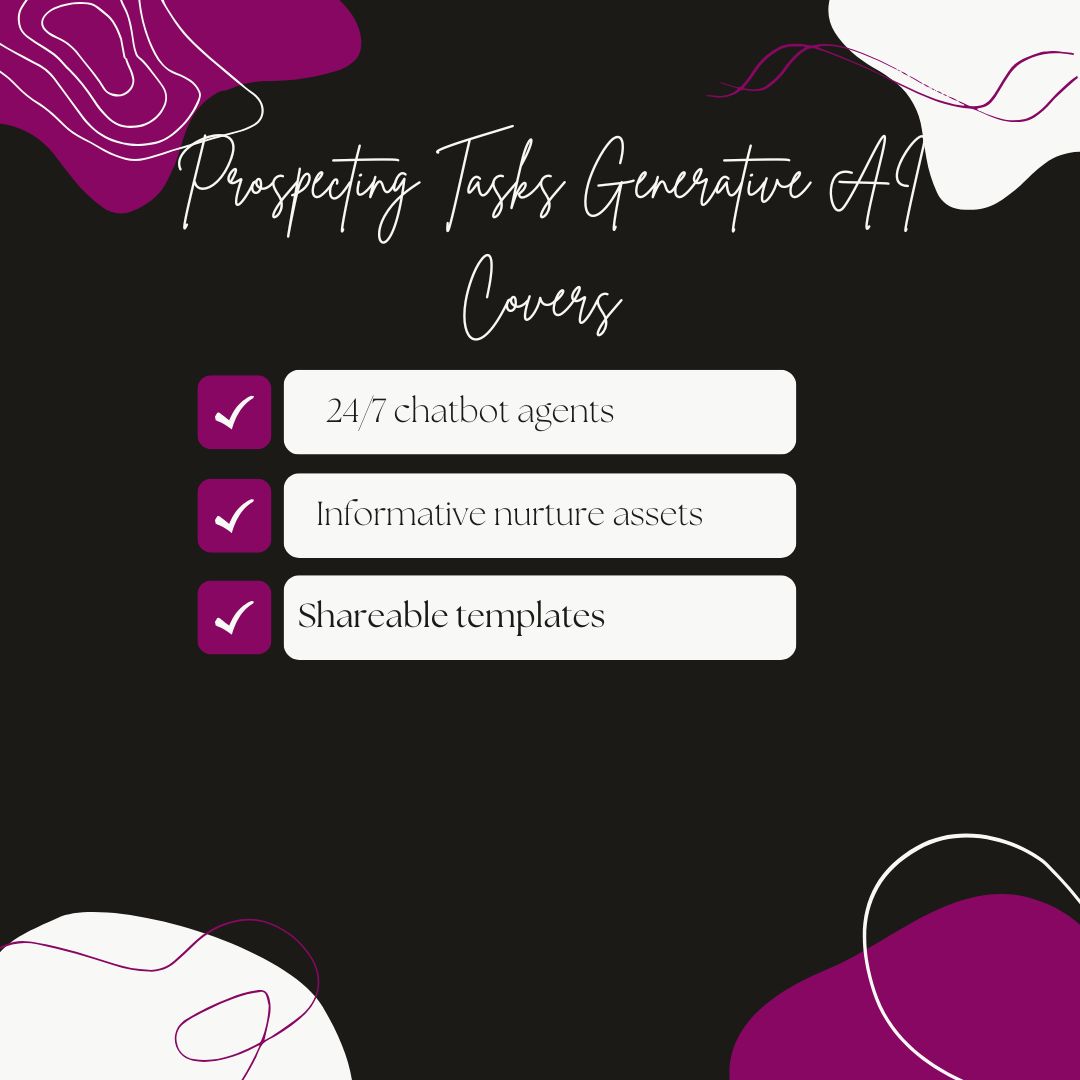
The same generative AI tools can handle other time-consuming aspects of prospecting. Automation helps sales teams produce:
- Chatbot agents that can answer questions 24/7
- Informative assets that convert
- Templates that can be shared across sales reps
Most importantly, outreach automation can scale up indefinitely. Even smaller sales teams can handle an ever-growing pipeline with AI on their side, as our 2026 AI in sales insights report suggests.
Best Practices for B2B Prospecting Automation
Sales automation tools eliminate many of the mental and manual parts of prospecting. However, these solutions aren’t magic wands. Sales teams still need to take care when using AI-powered automation, especially when many prospecting technologies are still in their early stages.

Whichever solutions you use, be sure to:
- Double-check for data accuracy – Like humans, AI can make mistakes. Use automation to speed up your processes, but always confirm that the results meet your standards. For instance, if you generate an email outreach template, read it over before sending it to catch any inconsistencies.
- Comply with ethical and legal frameworks – Respect the privacy laws and guidelines (i.e., CAN-SPAM, etc.) that protect your prospects. Depending on their region, that could mean providing an option to unsubscribe from emails, obtaining consent for communications, and more.
- Optimize communication cadence – In B2B, everyone is busy, the sellers and the buyers. So, respect your prospect’s time. Use automation tools to gauge interest, then tailor your messaging cadence to match your prospect’s eagerness. (Also, recognize when it’s time to stop sending emails.)
- Keep it human – No matter how much automation you employ, remember that it’s your human-ness that ultimately sells products. Sales has always been about relationships and trust, and AI doesn’t change that. If you internalize that automation is a useful tool, and not a replacement for connection, you’re ready to crush it.
Turn Research Automation Into Pipeline Growth
When you embrace automated prospecting and lead research, the results speak for themselves. Automation frees up time for sales teams to focus on selling, not on administrative tasks.
By speeding up the tedious, manual aspects of sales, you can increase efficiency and accelerate deal velocity. After all, the sooner a qualified lead enters your sales funnel, the sooner they can become a paying customer.
If you’re looking for the kind of automation that makes selling simpler, you need Seamless. Our AI-powered tools are designed to streamline prospecting, list-building, and much more.
Get a demo to discover what Seamless can do for your team.
Sources:
Salesforce. New Research Reveals Sales Reps Need a Productivity Overhaul – Spend Less than 30% Of Their Time Actually Selling. https://www.salesforce.com/news/stories/sales-research-2023/