That's why sales automation is so critical and in-demand.
It's like the ultimate sales weapon that can't be stopped.
The problem is getting the right tools setup to help your team succeed.
The reason? Every sales team, and even every salesperson, has their own workflow. However, one thing everyone can agree on is that sales workflows can be clunky, slow, and inconsistent.
That’s a big issue. The longer your workflow is, the longer it takes to close a deal.
If you feel like your team’s sales cycle moves too slowly, you need the right tools to automate sales workflow tasks.
Not sure where to start? Don't worry, that's what we do here and we’ve got your back. Here’s what to look for in workflow automation tools.
What Is Sales Workflow Automation?
Sales workflow automation is any solution that automates part of the sales process.
As it turns out, salespeople spend almost 70% of their work days on administrative (i.e. non-selling) tasks. So, for sales teams to meet increasingly ambitious revenue goals, salespeople need all the help they can get.
Enter automation.
When teams can off-load more tedious, time-consuming tasks to sales workflow automation, they free up more time for relationships, networking, and strategizing.
Automation ensures that every part of the sales cycle is:
Consistent
Efficient
Productive
Professional
Common Sales Workflow Bottlenecks
If you’re in sales, you’re likely already familiar with the most common time-stealing enemies. The tasks and gaps most likely to slow down sales teams are:
List building: Finding prospects to pursue can take a significant long time without the right automation tools.
Inefficient lead qualification: Salespeople often spend too much time on unqualified leads, and it’s not necessarily their fault. Bad data can make lead prioritization a mess.
Manual data entry: Inputting details into a spreadsheet after every call can eat up hours every week.
Categories of Sales Workflow Automation Tools
Of course, no one likes bottlenecks. For buyers, slowdowns lead to poor experiences; for sales teams, workflow congestion means missing quotas and staying late.
Fortunately, there’s a wealth of intelligent tools designed to automate, and speed up the typical sales workflow.
1. CRM and Pipeline Automation Tools
Customer relationship management (CRM) is the bread and butter of your sales cycle. Many automation tools exist to make relationship management more effortless, particularly when it comes to your sales pipeline.
The best tools to automate sales workflow can, in turn, streamline your:
Deal progression: Wherever your prospect is in the pipeline, automation can easily move them along. It can create buyer profiles, update them as deals change, and progress them smoothly through the pipeline.
Follow-ups: Missed communications become a thing of the past with automation. That’s because your system can automatically send follow-up emails when conditions are met or events are triggered.
Scheduling: Automated solutions can sync meetings and activities across calendars, email, and CRM platforms without you having to lift a finger.
2. Lead Management and Routing Tools
When it comes to finding and qualifying leads, you can also turn to automation tools. Software solutions can simplify every part of lead management, including:
Capture: Tools can automatically collect prospect information from web forms, landing pages, and more. Some advanced solutions can even research and build targeted lists.
Scoring: To help you determine where to focus your energy, automation solutions can analyze buyer intent and auto-prioritize leads.
Assignment: Even lead routing can be automated. The right software can assign leads to the right sales reps within seconds, using territory, deal size, and other variables as guidelines.
3. Reporting, Forecasting, and Analytics Tools
Automation can make simple decisions on your behalf using pre-determined logic. But it can also help you make better decisions.
With enough accurate data, automation tools can improve your:
Reporting: Any fact or figure can instantly become a dashboard or chart. Use automated solutions to regularly export performance reports, tracking any key performance indicators (KPIs) you choose.
Forecasting: With real-time and historical data, forecasting automation tools can continually update revenue projections.
Analytics: Automation can spot trends you might have otherwise missed. With AI-powered software, you can identify bottlenecks, examine win/loss patterns, and shorten your sales cycle.
Selecting the Right Tools for Your Sales Team
The field of workflow automation is crowded, with countless automation tools out there. How do you choose the right one(s)? You reflect on your needs.
As you explore workflow automation solutions, ask yourself these questions:
Is it scalable? The right tool will grow as your sales grow, accommodating new reps and processes as needed.
Does it integrate with other tools? Sales tech stacks need to work in harmony to really work. That’s why integrations are essential. Seamless already integrates with popular automation tools like Zapier and N8N.
Is it easy to use?The biggest hurdle in workflow automation is adoption, as people are resistant to change. Sales teams will only welcome new solutions if they don’t require a PhD to learn.
The best workflow tools should meet all of these criteria. And it just so happens that Seamless fits the bill.
With our AI prospecting tools, powerful list-building on autopilot, and more, you can automate away your sales workflow bottlenecks and focus on selling.
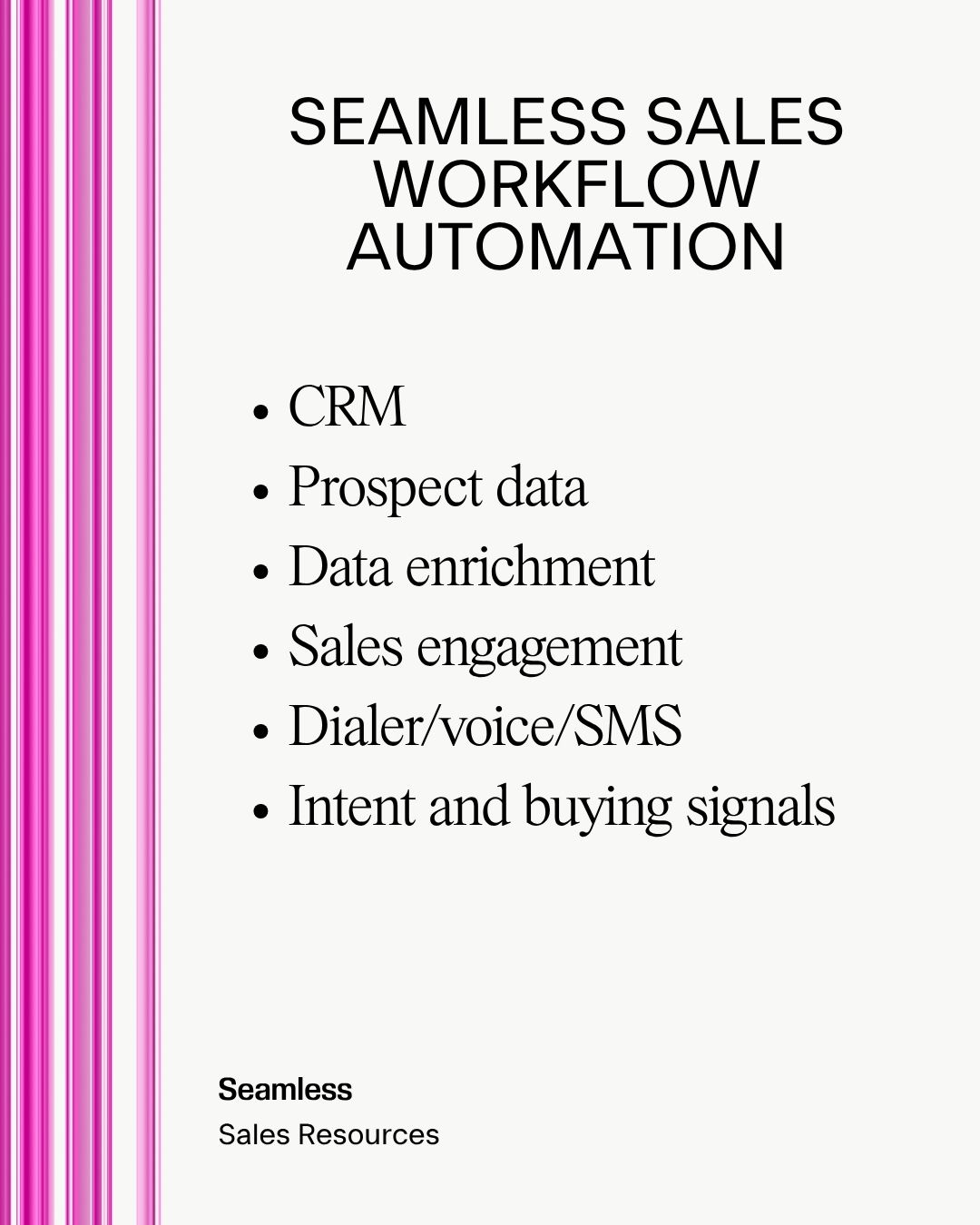
Here are the best tools for growth leader that are looking for a modern sales automation workflow, grouped by sales task or proesss with top options and quick notes:
CRM
Salesforce, HubSpot CRM, Microsoft Dynamics 365, Pipedrive, Zoho CRM
Choose based on ecosystem, admin resources, reporting depth, and API limits.
Sales intelligence and prospecting expert with years of experience to help sales teams grow and hit quota. Voted one of the top startups in America and rated as the highest software in Customer Satisfaction from G2 best software awards in 2025. Join our Reddit community for more product updates and sales tips. https://www.reddit.com/r/Seamless_AI/