Compare Cognism vs Seamless - Alternative Sales Tool Comparison
Seamless Team
February 12, 2026
This article compares Cognism vs Seamless.AI for prospecting, including how the two platforms differ across pricing, features, data, integrations, customer reviews, support, and overall value.
If you landed here, then you must really want to know how Cognism compares to Seamless.
Why? Because if you run your own business or play a huge part in the buying process when your team decides to add a new tool to the tech stack, then you already know that the right tool will help you and your staff drive productivity and hit growth goals.
When it comes to prospecting tools like Cognism and Seamless, there really isn’t a wrong answer, as both will help you find buyers, and turn them into a strong sales pipeline.
But the difference between a good prospecting tool and a great one isn’t the data, it’s the ROI. Does it just provide data? Or does it drive revenue for your team? Do the results you generate justify the price? Is there support in place to make sure you’re able to get the most value? Getting answers to these questions can ensure that you get a winning prospecting tool, and not a dud.
If you are ready to see the differences between Cognism and Seamless, keep scrolling, and we’ll show you how they stack up.
TL;DR: Cognism vs Seamless.AI
Seamless.AI is the better overall prospecting platform for most sales teams, especially those focused on fast contact discovery, list building, enrichment, outbound execution, and getting reps into pipeline-generating activity quickly.
Cognism is a strong option for organizations that prioritize enterprise data governance, compliance, and regional coverage, but Seamless offers broader day-to-day prospecting functionality and faster time to value for sales-led teams.
Cognism vs Seamless: The Scorecard
There is a lot to unpack when researching and comparing Cognism and Seamless. Things like price, reviews, features, and support all play a major role in the final decision.
We thought the best approach was to take each “comparison factor,” put Cognism and Seamless head-to-head, evaluate, and assign a grade. Then, from there, we will look at the overall ratings and give each tool a final score.
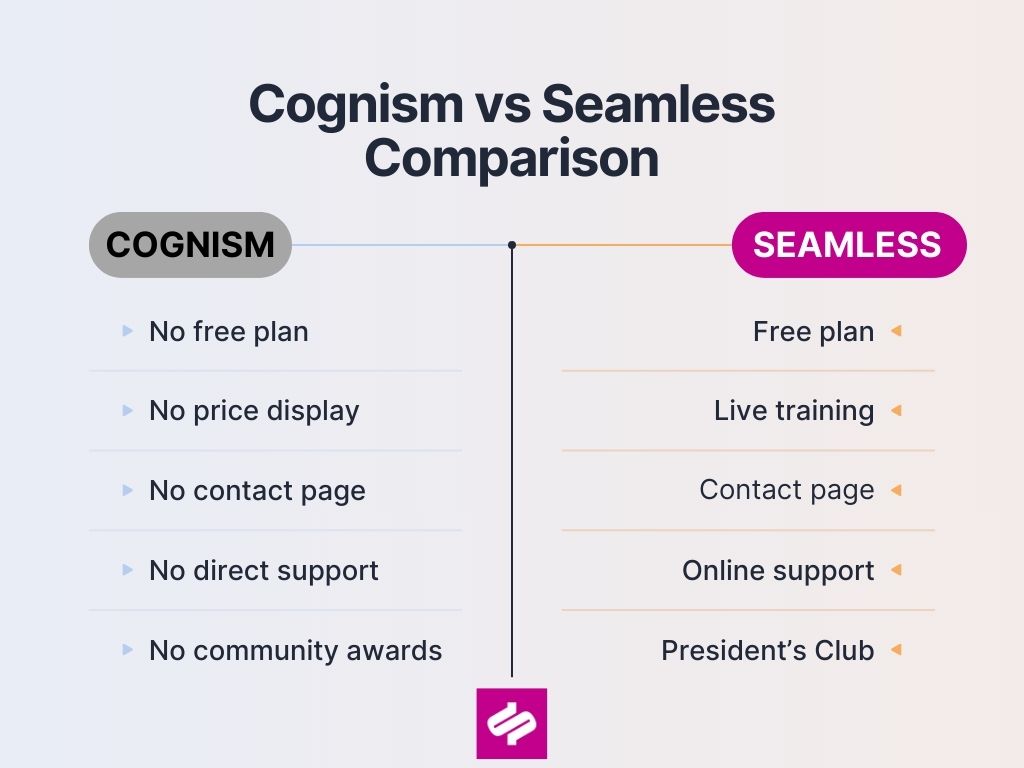
Cognism vs Seamless Comparison
Pricing
Pricing is one of the biggest factors when comparing Cognism vs Seamless.AI. Beyond the monthly or annual cost, teams should look at how much data, functionality, flexibility, and support they receive for that investment.
Cognism Pricing
Cognism offers sales intelligence, contact data, intent signals, firmographic data, and other prospecting capabilities. Its current packaging includes plans such as Grow and Elevate, with Elevate adding additional signals and intelligence capabilities.
Cognism does not prominently publish standard pricing for these plans on its website, so buyers generally need to speak with sales to receive a quote. That can make it harder for teams to compare costs before entering the sales process.
Pros:
Plans designed for larger B2B sales organizations
Includes contact, company, and intent data
Packaging can support more complex enterprise requirements
Strong option for teams that need international prospecting capabilities
Cons:
Pricing is not fully transparent upfront
Buyers typically need to speak with sales for a quote
Can create more friction for teams that want to evaluate cost before a demo
May be more platform than smaller or highly self-serve teams need
Cognism's pricing model can still make sense for its target customer. Larger organizations that prioritize international coverage, compliance, governance, and enterprise sales intelligence may be comfortable with a sales-led buying process and customized pricing. The tradeoff is that smaller teams or buyers looking for immediate price transparency may find the process heavier than necessary.
Grade: C+
Seamless.AI Pricing
Seamless offers multiple pricing options, including a free plan that lets users begin prospecting without first going through a sales process.
Paid Seamless plans provide additional credits and access to capabilities such as contact data, real-time search, buyer intent, job-change signals, automated list building, AI-powered research and messaging, CRM integrations, and outbound workflows.
Seamless also uses a flexible credit model that allows teams to spend credits based on the data and capabilities they actually use rather than treating every contact lookup the same.
Free option lowers the barrier to testing the platform
Public pricing makes comparison easier
Flexible credit usage across different types of prospecting data
Teams can prioritize emails, phones, full contacts, AI, and other capabilities
Designed to support both individual sellers and larger sales teams
Faster path from evaluation to active prospecting
Cons:
Credit-based pricing requires teams to understand their expected usage
High-volume organizations may still need a larger or customized plan
Enterprise requirements may require a conversation with sales
For teams that value pricing transparency, flexibility, and the ability to start prospecting quickly, Seamless has an advantage. Cognism may still be a better fit for organizations that expect a more enterprise-oriented purchasing process and place greater emphasis on specialized governance or international data requirements.
Grade: B
Reviews
Now that we have a level set on the pricing and features for both Cognism and Seamless, it’s good to look at what customers are saying about them on G2, Capterra, etc.
Cognism Reviews
Overall, Cognism has a favorable reputation and decent ratings.
On G2, where they are listed in Sales intelligence, Lead intelligence, and Market Account Intelligence, they have a rating of 4.5 out of 5 on 1,287 reviews.
One user on G2 stated, "The main drawback is the accuracy of employee data. It’s not uncommon to find prospects listed who have left their companies."
While another Cognism reviews says, "Occasionally, some of the contact data can be outdated or missing for niche industries or smaller regions, but this is quite rare".
On Capterra, it's a very similar story with 4.7 out of 5 on 251 reviews.
Both sites show that Cognism has a good product that supports their customers, but on TrustPilot, they have a rating of 3.4 out of 5 with some negative reviews.
With ratings comparable to others in this space and no major outstanding issues, Cognism is a reliable option for users.
Grade: B
Seamless Reviews
There are no shortages of positive reviews, accolades, and accomplishments for Seamless.
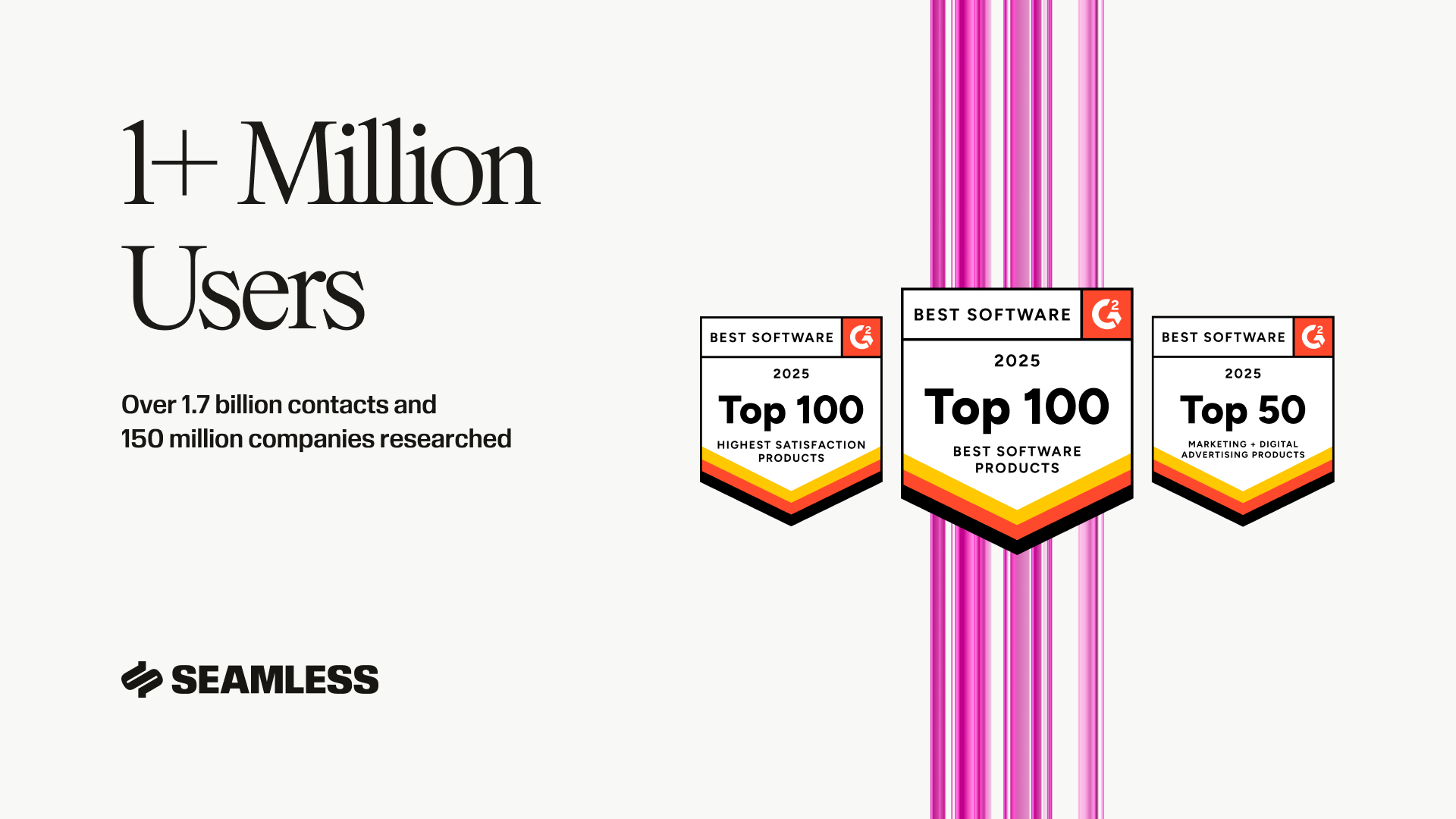
Being rated #1 on G2 in 2025 for best software product with the highest customer satisfaction and a 4.4 out of 5 on 5,288 reviews in Lead Capture, Sales Intelligence, and Lead Intelligence makes Seamless a great choice for sales teams.
One user wrote, "What I like most about Seamless.AI is how accurate and comprehensive the contact data is, especially when it comes to identifying decision-makers and qualified leads".
Another Seamless reviews states, "I really like Seamless.AI for its large contact database and prospecting speed".
With over 3x more reviews than Cognism and, as reviewers, point out, a strong focus on satisfying customer needs, Seamless comes out ahead.
On Capterra, Seamless also rates 4.4 out of 5. The team at Seamless has been featured in the Capterra Shortlist for 2 years in a row in the “Lead Generation” category.
Overall, with high ratings and solid reviews on the most trusted tech tool review websites and B2B networks, Seamless is a clear winner with our customers.
Grade: B+
G2 2025 Seamless Ratings
Support
Support matters because a prospecting platform only creates value when teams can adopt it, troubleshoot issues, and get help improving their workflows.
Cognism Support
Cognism provides customer support and enablement resources for its users, particularly for organizations using the platform across larger sales and revenue teams.
Its customer experience is generally built around a more traditional B2B SaaS sales and account-management model.
Pros:
Customer support available for paying users
Designed to support larger sales organizations
Enablement resources can help teams with implementation and adoption
Enterprise customers may receive more structured account support
Cons:
Getting help before becoming a customer may involve more sales-led steps
The buying and onboarding experience may feel heavier for smaller teams
Less suited to users who want to sign up and begin independently
Cognism's approach is not necessarily a weakness for its target market. Larger organizations often expect a structured implementation, account management, and enablement process. For an individual seller or smaller team that wants to move quickly, however, that additional structure can create unnecessary friction.
Grade: C+
Seamless.AI Support
Seamless offers multiple support and education options designed to help customers start prospecting quickly and continue improving how they use the platform.
Support extends beyond troubleshooting to resources such as live training, webinars, product education, customer support, and sales assistance.
Pros:
Multiple ways for customers to get help
Live training and educational resources
Support for both product questions and prospecting workflows
Designed to help reps reach value quickly
Suitable for self-service users as well as larger organizations
Cons:
The level of hands-on support can vary by plan
Larger or more complex organizations may still require structured onboarding
Teams using advanced integrations may need additional technical support
For sales teams focused on getting reps productive quickly, Seamless's combination of self-service access and ongoing education can reduce the time between buying the platform and generating value from it.
Grade: A-
How Does Cogism Compare to Seamless
There are many ways that Cognism compares with Seamless including product features, ratings and reviews, as well as competition.
They both provide contact information and intent data for customers to improve their prospecting efforts and generate more leads for sales.
Integrations
Integrations determine how easily prospecting data moves into the systems sales teams already use. Both Cognism and Seamless connect with common CRM and sales tools, but they tend to emphasize different types of workflows.
Cognism Integrations
Cognism integrations are often evaluated by organizations that want prospecting and enrichment data to flow into a broader revenue operations infrastructure.
Common use cases include CRM enrichment, contact syncing, sales engagement workflows, and maintaining data across larger GTM systems.
Pros:
Integrates with major CRMs such as Salesforce and HubSpot
Supports sales engagement and enrichment workflows
Well suited for centralized RevOps and data-management use cases
Can support larger-scale enrichment strategies
Cons:
More sophisticated workflows can require additional setup
May depend more heavily on RevOps or administrators
Can be more complex than necessary for teams focused primarily on day-to-day prospecting
That complexity can be worthwhile for Cognism's target customer. Organizations with dedicated operations teams, established data processes, or complex international sales motions may value deeper governance and enrichment workflows more than immediate rep-level simplicity.
Seamless.AI Integrations
Seamless integrations are designed to reduce the distance between finding a prospect and taking action on that prospect.
Sales teams can use Seamless to identify contacts and companies, then move that data into systems such as Salesforce, HubSpot, Salesloft, Outreach, and other sales and marketing platforms. Seamless also supports API and automation-based workflows for teams that need deeper connectivity.
Pros:
Integrates with major CRM and sales engagement platforms
Designed around fast prospect-to-CRM workflows
Makes it easier for reps to act on newly discovered contacts
Supports CRM syncing, exports, automation, and API workflows
Strong fit for teams that want prospecting embedded into everyday sales execution
Cons:
Advanced integrations may require RevOps or technical configuration
Organizations with highly specialized data architectures may need custom API workflows
Some enterprise workflows may require more implementation than basic rep-level integrations
The biggest difference comes down to how the integrations are used. Cognism can be a strong fit for organizations prioritizing structured enrichment and centralized data operations, while Seamless is particularly well suited to teams that want reps to find prospects, sync them into the sales stack, and begin outreach with minimal delay.
Where Cognism Falls Short...And Where It Still Makes Sense
Cognism can fall short for teams that prioritize self-service buying, immediate prospecting, transparent pricing, and lightweight rep adoption. Its enterprise-oriented approach may introduce more steps between evaluating the platform and putting data into the hands of sellers.
That does not make Cognism a poor prospecting platform. Its strengths align well with companies that prioritize international data coverage, compliance, governance, and structured enrichment across larger revenue organizations. For those buyers, the additional complexity can be justified.
For teams whose primary goal is to find leads quickly, move them into existing sales workflows, and start generating pipeline, Seamless offers a more direct path from prospect discovery to sales execution.
Seamless Over Cognism
When the priority is speed and rep adoption, Seamless is the better choice because it’s typically used to help sellers find contacts quickly, build lists with minimal setup, and move prospects into outbound workflows fast (often via a browser-driven experience and straightforward export/CRM push).
Why?
If your team is measured on near-term pipeline activity, Seamless wins out because it reduces the friction between “I need leads now” and “I’m emailing/calling today,” which often matters more than having the most elaborate data-ops tooling.
Seamless is also a strong pick when you want a lighter-weight implementation—less dependency on admin-heavy enrichment projects and more immediate value for individual reps or smaller teams.
Before you think about committing to Seamless or Cognism, you’ll want to do a pulse check on your business needs and what matters most to you.
If you have a greater need for data coverage, governance/compliance controls, and integration depth, Cognism is the way to go.
But if you need fast prospecting + quick activation, Seamless is often the more pragmatic, time-to-value option.
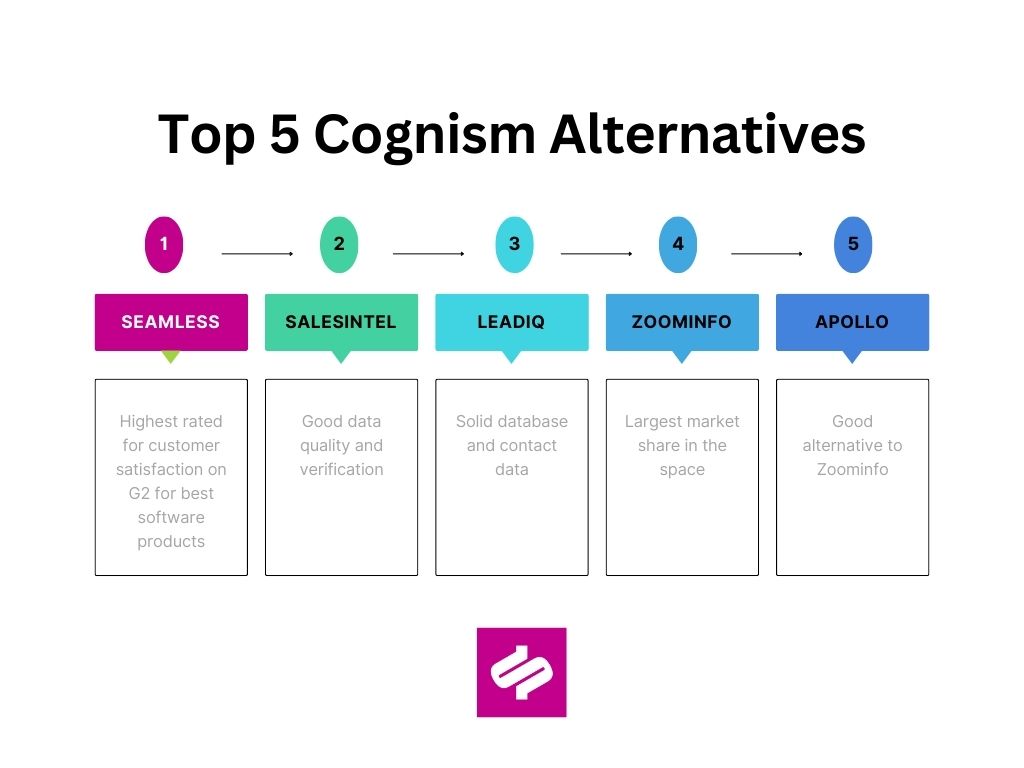
If Cognism just doesn’t cut it for you, according to G2, Capterra, and Reddit, competitive alternatives to Cognism include:
Top 5 Cognism Alternatives
Top 10 Cognism Alternatives
Seamless - Highest rated for customer satisfaction on G2 for best software products
SalesIntel - Good data quality and verification
LeadIQ - Solid database and contact data
ZoomInfo - Largest company in the space
Apollo - Good alternative to Zoominfo
Lusha - Simple and fast solution with low entry barrier
RocketReach - Reliable data and fast setup
Clearbit - Good data and reliable support
Hunter - Alternative with decent metrics
LinkedIn Sales Navigator - Contender by data proxy
Cognism vs. Seamless.AI: Side-by-Side Feature Comparison Table
For a faster way to compare the two platforms, the table below breaks the discussion into the main evaluation areas covered throughout the article. It’s designed to make the differences easier to review at a glance.
Feature
Cognism
Seamless.AI
Contact Discovery
Contact and company data for sales intelligence and prospecting
Real-time contact discovery built for fast daily prospecting
Company Discovery
Strong company intelligence and enterprise data coverage
Company search with firmographic, account, and buyer insights
Email & Phone Data
Provides business emails, direct dials, and mobile data
Real-time verified emails, direct dials, and mobile numbers
Data Verification
Structured data verification with an emphasis on enterprise data quality
Verifies contact and company data in real time as users search
Data Enrichment
Strong fit for CRM enrichment and larger data-management programs
Real-time enrichment designed to support prospecting and outbound workflows
Buyer Intent
Available for identifying accounts showing buying signals
Buyer Intent available alongside prospecting, enrichment, and outreach
International Coverage
Strong emphasis on global coverage and compliance-oriented workflows
Broad prospecting coverage with real-time search across markets
Compliance & Governance
Major strength for enterprise teams with regional and governance requirements
Supports compliant prospecting while emphasizing speed and sales execution
List Building
Supports prospect and account list creation
Fast list building with search, filtering, and automation
Sales Execution
Often feeds data into existing sales engagement systems
Designed to move directly from prospect discovery into outreach
Integrations
Strong CRM, enrichment, and RevOps integrations
CRM, sales engagement, API, automation, and outbound integrations
CRM Workflows
Well suited for centralized enrichment and data-management workflows
Built for quick prospect-to-CRM syncing and rep-level execution
API & Automation
Supports enterprise data and integration workflows
Supports API, automation, enrichment, and prospecting workflows
Pricing Model
Quote-based enterprise pricing with plans such as Grow and Elevate
Free and paid plans with credit-based usage and enterprise options
Free Access
Typically sales-led evaluation rather than a self-service free experience
Free plan lets users begin prospecting before speaking with sales
Ease of Adoption
More structured implementation, particularly for enterprise teams
Faster self-service adoption for individual reps and sales teams
Product Support
Structured support and enablement for larger organizations
Customer Success, training, education resources, and self-service support
Best Fit
Larger organizations prioritizing governance, compliance, international coverage, and structured enrichment
Sales-led teams prioritizing speed, list building, enrichment, and outbound execution
Time to Value
Can require more setup and operational involvement
Designed for quicker setup and faster movement from lead discovery to outreach
Overall Workflow
Centralized data enrichment, governance, and enterprise sales intelligence
Find, enrich, sync, and engage prospects with minimal friction
Final Comparison Grade & Outlook
Looking at the main buying points when comparing Cognism to Seamless, both have comparable features, ratings, and support, but ultimately one choice is better than another.
While Cognism delivers decent results and features, its overall grade value is a B-.
Seamless, which consistently delivers great results and has an established reputation in the B2B SaaS space, scores a B+.
While Cognism is often considered for enterprise-style data governance and structured enrichment, Seamless tends to deliver faster, better day-to-day prospecting value. Seamless makes it easier for reps to find contacts and reach out with minimal friction.
If your main goal is quick list building and immediate outbound execution (rather than heavier admin controls), Seamless is the more practical, time-to-value choice than Cognism.
Ready to try Seamless today? You can start for free now, or speak with one of our reps by booking a demo to see customized pricing that fits your needs.
Frequently Asked Questions About Cognism vs. Seamless
What is the main difference between Cognism and Seamless.AI?
The main difference between Cognism and Seamless.AI is how each platform is typically used. Cognism is often evaluated for enterprise data coverage, governance, enrichment, and compliance-oriented workflows, while Seamless is more focused on fast prospecting, real-time contact discovery, list building, enrichment, and outbound execution.
Which is better for outbound sales: Cognism or Seamless?
Seamless.AI is generally better suited for outbound sales teams that need to find prospects and start outreach quickly. The platform's workflow is designed to reduce friction between contact discovery, list building, CRM syncing, and sales engagement, making it useful for SDRs, BDRs, and AEs focused on near-term pipeline creation.
Is Seamless.AI a good Cognism alternative?
Yes, Seamless.AI can be a strong Cognism alternative for sales teams that want faster prospecting, easier list building, real-time contact search, enrichment, buyer intent, and outbound execution. Seamless.AI is a great choice if you're looking to get set up quickly and start driving leads and value sooner rather than later.
Can Seamless.AI replace Cognism?
Seamless.AI can replace Cognism if you're looking for accurate contact discovery, enrichment, and buyer intent, lightning-fast list building, and smooth prospecting workflows. Teams that depend heavily on Cognism for specialized governance, regional compliance, or complex enterprise data operations should evaluate those requirements separately.
Who should choose Seamless.AI instead of Cognism?
Seamless.AI may be a better fit for sales-led teams that are looking to run fast prospecting, accurate contact discovery, list building, enrichment, buyer intent, automation, and immediate outbound execution. It is especially relevant for teams looking to shorten the time between finding a lead and booking a meeting.
Is Seamless.AI accurate?
Yes, Seamless.AI is accurate for B2B prospecting, using real-time search and verification to help surface current business emails, direct dials, and mobile numbers. Accuracy can vary by contact and market, but Seamless continuously refreshes and verifies data to help reduce outdated information and improve prospecting reliability.
Sales intelligence and prospecting expert with years of experience to help sales teams grow and hit quota. Voted one of the top startups in America and rated as the highest software in Customer Satisfaction from G2 best software awards in 2025. Join our Reddit community for more product updates and sales tips. https://www.reddit.com/r/Seamless_AI/